
If you need hands-free, ready-to-go power when the grid fails, an auto-start generator is the right choice. These units wake up with automatic starting methods and provide seamless backup for homes, offices, or RV setups. This guide highlights five top options suited to different needs—from large home protection to compact travel-friendly power. Read on to compare start methods, fuel options, outlets, and running times so you can choose the best auto-start generator for your situation. The table below summarizes the featured models for quick reference.
| Model | Fuel | Best For | Key Benefit |
|---|---|---|---|
| Westinghouse 12500 Watt Dual Fuel | Gas/Propane | Large homes, transfer-ready | High power, remote start, transfer switch ready |
| WEN 4750/3800 Dual Fuel | Gas/Propane | Mid-size backups | Compact dual-fuel with wheel kit |
| Westinghouse 4650 Peak Dual Fuel | Gas/Propane | RV/small homes | Multiple outlets, CO sensor |
| Westinghouse 5000 Peak Inverter | Gas | Travel trailers, apartments | Quiet, inverter power with USBs |
| GENMAX 6250 Tri-Fuel Silent Inverter | Gas/Propane/Natural Gas | Home and RV with flexible fuel | Bluetooth app, multiple outlets |
Buyer type guidance: homeowners seeking robust full-house backup often pick larger dual-fuel models with transfer switch readiness. RV users benefit from RV-ready outlets and low THD in inverter designs. Budget-conscious buyers may prefer mid-range dual-fuel units with wheel kits. For those with limited space or noise concerns, quiet inverter options provide usable power without disturbing surroundings. This article uses objective specifications to help you decide which auto-start generator best fits your needs.
Westinghouse 12500 Watt Dual Fuel Generator

This unit runs on gasoline or propane with a remote start and an included key fob. It includes a transfer switch-ready configuration and multiple outlets: two standard 120V outlets with GFCI protection, plus a 30A and a 50A RV-ready outlet. It’s powered by a 457cc Westinghouse four-stroke engine with automatic low oil shutdown and a digital hour meter. The VFT display shows real-time voltage, frequency, and lifetime hours for quick status checks.
Best for: Large homes or properties requiring strong peak power and transfer-switch readiness. This model is well suited for households that want a hands-off approach to backup power during outages, especially when a full-house load is anticipated. It is less ideal for compact spaces due to its size and weight.
Caution: The unit’s high power output requires careful installation with a compatible transfer switch and proper ventilation to avoid exhaust buildup. Ensure fuel storage complies with local regulations.
WEN 4,750-Watt Dual Fuel Portable Generator

With a simple switch between gasoline and propane, this generator provides 4,750 surge watts and 3,800 running watts on gasoline, and 4,350 surge/3,500 running watts on propane. It can deliver 120V to 240V, which is ideal for transferring power to essential circuits or a transfer switch. It includes an electric start powered by a 224cc engine and a wheel kit for easier transport.
Best for: Mid-size backup needs where portability and cost are priorities, such as small homes, workshops, or cabins. Choose this if you want a versatile, moveable unit with straightforward dual-fuel operation. Avoid this if you need continuous high-load power for an entire home for extended outages.
Westinghouse 4650 Peak Dual Fuel

This compact dual-fuel option delivers 3,600 running watts and 4,650 peak watts on gasoline, and 3,240 running watts with the same peak on propane. It features a four-gallon fuel tank with a fuel gauge and a remote start plus an auto choke. Available outlets include a 5-20R 120V duplex, RV TT-30R, and L5-30R for broader compatibility. It supports easy gas-to-propane switching without turning off the unit.
Best for: RV owners and light-reserve users needing a compact, reliable power source with multiple outlet configurations. Better for portability than for full-home backup. Caution: running time is limited by fuel capacity, so plan for shorter outages.
Westinghouse 5000 Peak Inverter

This inverter generator runs on gasoline with a peak of 5,000 watts and 3,900 rated watts, delivering cleaner power suitable for sensitive electronics. It includes a remote start with auto choke, a wheel kit, and an RV-ready TT-30R outlet in addition to a 5–20R duplex outlet and two USB ports. The unit is designed for travel trailers or home use where quiet operation matters.
Best for: Quiet operation and travel-friendly backup. Choose this if you need clean power for electronics like laptops and phones while on the go. Limitation: higher initial cost and potentially lower continuous output compared with non-inverter, larger models.
WEN 4800-Watt Dual Fuel Inverter

This model operates on gasoline or propane with 4,800 surge watts and 4,000 rated watts on both fuels. It is designed for quiet operation and features clean power to protect sensitive electronics. It is RV-ready with a CO watchdog, ensuring safe operation in enclosed spaces and during long camping trips. It also offers an electric start for quick, hands-free operation.
Best for: Users prioritizing quiet operation and sensitive electronics protection. Choose this if you want a compact, travel-friendly inverter with robust safety features. Limitation: not the largest power option for full-house emergencies.
WEN 6800-Watt Tri-Fuel Inverter

This generator offers 6,800 surge watts and 4,500 running watts on gasoline or propane, with a natural gas option. It features a bonded-neutral 240V configuration for Level 2 EV charging and a CO watchdog to shut down on danger. The unit includes multiple outlets (20A, 30A, 50A) and a digital control panel with start methods, including Bluetooth app control, electric, remote, and recoil starts.
Best for: Homes requiring flexible fuel sources and EV charging capability, plus smart monitoring. Choose this if you want advanced control and a broad outlet selection. Limitation: tri-fuel systems add complexity and require careful setup for optimal performance.
Westinghouse 14500 Peak Tri-Fuel
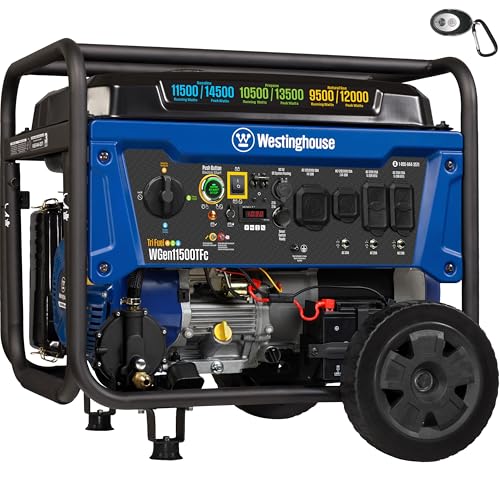
This large backup unit offers 14,500 peak watts and 11,500 running watts on gasoline, with substantial performance on propane and natural gas. It runs up to 19 hours on a 9.5 gallon tank and features a heavy-duty 550cc engine with a cast-iron sleeve. The model is designed for substantial whole-home or workshop power and includes multiple fueling options and transfer-switch readiness.
Best for: Large homes, barns, or clinics requiring substantial peak power with flexible fuels. Choose this if you need robust, long-duration backup. Caution: installation complexity rises with higher power outputs, and fuel availability becomes a key consideration during outages.
Buying Guide
What should you consider when choosing an auto-start generator? Start with power needs: calculate your essential circuits and plan for peak load. If you want seamless transfer during outages, pick a model with transfer-switch compatibility and a remote or automatic start feature.
Fuel type matters: dual-fuel units offer flexibility during fuel shortages, while tri-fuel options maximize adaptability for home, RV, or remote use. For electronics-heavy loads, choose inverter generators with clean power (<3% THD) and built-in CO sensors for safety.
Portability vs. capacity: larger units deliver more power but require more space and ventilation. If mobility is important, consider wheel kits and lighter models. Noise levels matter in residential areas, so inverter generators are typically quieter.
Outlets and safety: ensure outlets align with your needs (GFCI, RV, 240V, USB). A CO sensor and automatic shutoff add safety for enclosed spaces. Verify fuel capacity and expected runtime to align with outage duration expectations.
FAQ
- What is an auto-start generator? It is a generator with automatic starting when a power outage is detected, or via remote/electric start control.
- Which fuel type is best for home backup? Dual-fuel or tri-fuel units offer flexibility if gas or propane supplies are inconsistent.
- Do inverter generators provide clean power? Yes, most inverter models produce low THD power suitable for electronics.
- What is transfer-switch readiness? It means the unit can be connected to a home transfer switch to safely switch circuits from grid to generator.
- Is louder always better for power? No, quieter inverter models are often preferred for homes and RVs, though they may have lower peak output.
- How long do these generators run on a full tank? Runtime varies by model and load; high-capacity tanks extend operation for outages.
